Plastic Financing

Plastic Financing – Blockchain Startup in Plastic Waste Management

Every year, we produce more than 2 billion tons of waste, according to the United Nations. Global waste is likely to reach 3.40 billion tons by 2050, more than double the rate of population increase over the same time period. The average amount of waste generated per person per day is 0.74 kilograms, although this varies from 0.11 to 4.54 kilograms. This percentage is likely to increase by 40% in low- and middle-income countries and 19% in high-income countries by 2050.
THE PROBLEMS WE FACE 
We want to talk about two things. The first concerns a poor recycling system, which prevents people from living in a circular economy. Second, about an important but under -served garbage community.
INSUFFICIENT RECYCLING SYSTEMS CIRCULAR ECONOMIC IMPACT:
Garbage recycling is one type of wealth generator. It has the potential to stimulate grass root investment by the poor, create jobs, reduce poverty, save city money, increase industrial competitiveness, conserve natural resources, and protect the environment.Promoting a circular economy in the context of plastics can be achieved by maximizing recycling efforts.Most plastics can only be recycled three times due to their chemical properties, with each recycling process producing a polymer at a lower content. Plastic will be destroyed after the recycling process, polluting our environment indefinitely.COMMUNITY IS IMPORTANT BUT WASTE The fact that the garbage population in landfills suffers, especially in poor countries, is an irony. Landfills rely on informal labor as scavengers, scavengers, haulers, and all work in the recycling process due to the city’s ineffective recycling infrastructure. As a result, landfills provide a source of income for millions of people.Garbage villages are also denied access to the banking system, even though they need it.The majority of scavengers and scavengers are unpaid volunteers with little income. Denying them access to the financial system prevents them from obtaining more productive instruments. In addition, because they are usually not financially educated, they fall prey to moneylenders. This has a negative impact on their well -being.
SOLUTIONS:
Blockchain technology and a stable currency can help streamline finances for the plastic recycling business, empower the waste community, and become an ESG investment model.we propose three pillar solutions:Tokenization can help increase the transparency of wasteful costs. DeFi provides economic and social empowerment to the garbage community. Ensure the long -term sustainability of this movement by using security tokens, and implement this project as an LST investment model. We give tokens to every form of plastic waste and build internal exchanges using smart contracts, so that everyone in the waste supply chain can easily monetize plastic waste. Blockchain This technique increases price transparency and can be used as a tracker for better waste management.After that, we developed DeFi DApss, which allows garbage to be used as an asset. Scavengers and the community will be able to raise funds to increase their yields thanks to deFi. Finally, governance tokens that also act as dividend tokens will ensure the survival of the circular economic model in the long run. By making this approach an LST investment, we can increase its potential for global adoption.
How the Platform Works
 
Plastic Finance  works in two ways: empowering the garbage community (such as scavengers, scavengers, etc.) and giving rewards to those involved in the network. Scavengers will be rewarded for their contributions, where they have the option to earn money in the form of tokens or fiat (real) money. If they prefer crypto tokens, they can actually take part in the platform. They can use this platform to gain financial access, and this is rare because the junk community is usually a party that does not have a bank account. Well, with this platform, these unbanked people can finally enjoy financial access
 
OUR MISSION 
BY IMPROVING THE RECYCLING SYSTEM, WE SUPPORT THE CIRCULAR ECONOMY:Plastic Finance focuses on plastic recycling by increasing the productivity of scavengers. We do not disrupt the waste value chain; rather, we add value to it, benefiting all stakeholders. Furthermore, we are sponsoring tree replanting initiatives to extract carbon from CO2 emissions, strengthening our commitment to the circular economy.WE ENABLE THE WASTE COMMUNITY SO THAT THEY HAVE A BETTER SOCIAL STATUS IN THE COMMUNITY:The goal of Plastic Finance is to empower the garbage community. We concentrate on activities that will increase their self -esteem, which will increase their productivity and well -being.WE IMPLEMENT DEMOCRATIC ACCESS TO LST INVESTMENT:With the support of the investor community, we can sustain and grow our efforts to enrich the recycling system and empower the waste community. We democratize access for everyone to participate in the global goal of recycling and empowering people with DApps and DeFi.STABLE COIN AND BLOCKCHAIN ​​TECHNOLOGY:Can play an important role in motivating every home and MRF to simplify the funding of the plastic recycling industry. Using smart contracts, we can tokenize all types of regrind and plastic pellets, as well as build internal exchangers, allowing consumers and industry to easily monetize plastic waste. Next, we can develop DeFi Dapps that allow this garbage to be used as an asset.
Tokenomics
 
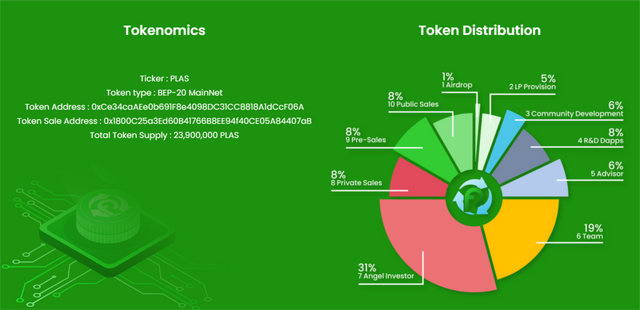
Ticker: PLASToken Type: BEP-20 MainNetToken Address: 0xCe34caAEe0b691F8e4098DC31CC8818A1dCcF06AToken Sale Address: 0x1800C25a3Ed60B41766B8EE94f40CE05A84407aBTotal Token Supply: 23,900,000 PLASimage.png
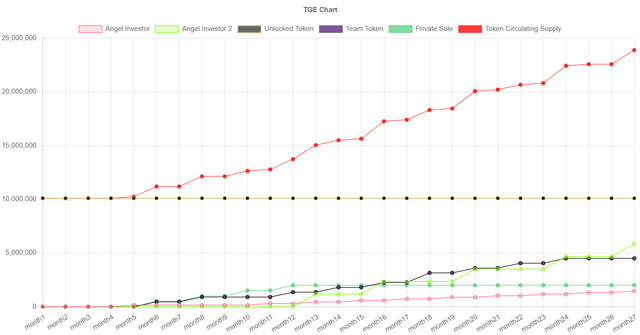
Token Creation Event
 
image.png
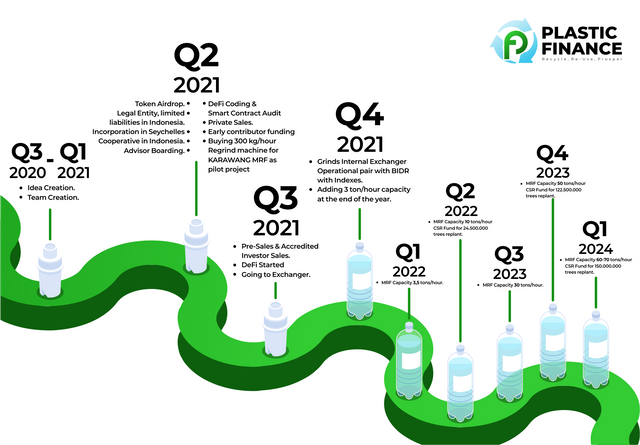
ROADMAP
 
image.png
DOCUMENT
 
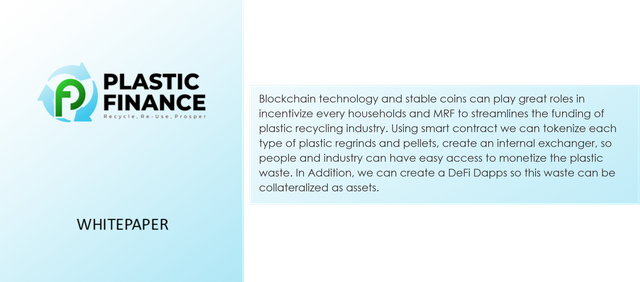
image.pngBlockchain technology and stable coins can play a big role in incentivizing households and MRFs to streamline the funding of the plastic recycling industry.  Using smart contracts, we can tokenize every type of plastic regrind and pellet, create an internal exchanger, so that people and industry can have easy access to monetize plastic waste.  In addition, we can create DeFi Dapps so that these wastes can be pledged as assets
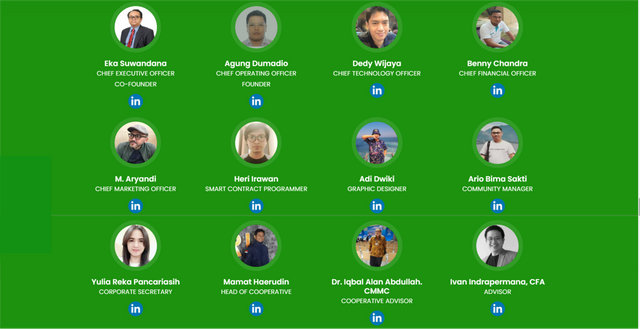
TIM
 
image.png
Useful links to projects
https://plastic.finance/https://linkedin.com/company/plastic-financehttps://twitter.com/plastic_financehttps://t.me/plasticfinancehttps://www.facebook.com/Plastic-Finance-110471187905120https://www.instagram.com/official_plasticfinance/https://www.tiktok.com/@plastic.finance?https://www.youtube.com/channel/UCxZvaGVdcOJ-_SnGaEn4kewhttps://medium.com/@Plastic_Financehttps://plastic.finance/whitepaper.pdfby yufiezz link https://bitcointalk.org/index.php?action=profile;u=2979093

Leave a comment

Design a site like this with WordPress.com
Get started